Grursus mal suada faci lisis Lorem ipsum dolarorit ametion the at dummy consectetur elit. Vesti at bulum nec odio aea the dumm ipsum on that at to dolocons rsus mal suada and fadolorit to the consectetur elit.
Remember in your undergrad psych class when you had to learn about Abraham Maslow’s Hierarchy of Needs? (I know, it’s been a while…) As a refresher, Maslow’s theory was that humans have certain needs, and that some are more important than others. Basically, if your fundamental needs aren’t met, you can’t have the luxuries in life. As it turns out, this theory applies to your client experience strategy, too.
The Foundation: Stuff We Literally Can’t Live Without
In Maslow’s hierarchy of needs, the base of the pyramid consists of physiological needs. These are things like food, water, warmth, rest—basic necessities for human survival. In marketing, it’s about ensuring that your product or service covers all the basic needs of your audience. Before you can get fancy, you have to make sure it serves its purpose.
For a marketing agency like Silverbrook, our audience is people who need marketing services. Let’s niche it down even further and say that our specific audience is small business owners who need graphic design. (Hi!) Our service—the design work—has to serve the audience’s basic needs: it has to contain all pertinent information to be conveyed. That’s it. It’s the bare minimum, but that’s the most important part.
Still Important: Seatbelts and Bubble Wrap
Safety first, right? Well, almost. The next most important level is safety needs, including security. Your brand should aim to be the seatbelt in the wild rollercoaster of life, along with a snug security blanket of reliability. You have to make your audience feel secure in their decision to purchase your product or service.
For Silverbrook, we aim to give all our prospective clients reasons to trust us with their projects and show that their reputations are in good hands. A good way to do this is to share social proof—testimonials, reviews, and other feedback from “real people” who have used our services in the past. A great review from a happy client makes a massive impact on someone else looking to sign a contract for the same service.
The Next Level: Feeling the Love
The middle level of Maslow’s hierarchy of needs pyramid is belongingness and love needs. The need to love and be loved, whether it’s through intimate relationships or platonic ones. People need to feel connected to other people (and I’d argue that pets fall into this category as well, to a lesser extent). We all know that marketing isn’t just about selling stuff; it’s about creating a vibe, a community. You want to position your brand as a favorite buddy who shares the latest gossip over a Frappuccino.
I’ve made a priority out of customer experience in my business. At Silverbrook, we treat our clients like family. Better than family, really, because we are always polite and rarely deny them anything, unlike our real families! We also try to make sure we are always engaging on social media and answering any comments to make sure our audience feels like they’re a part of the “in crowd.” We are a small club, but we’re a welcoming one!
Near the Top: Earning High-Fives All Around
Only one level from the pinnacle, esteem needs are about feelings of accomplishment and pride. Your audience wants everyone to know that they are responsible for the awesome results from their decision to use your company. You want to give them the warm fuzzies, making them look good in front of their bosses and peers.
Silverbrook doesn’t just give our clients what they ask for. Continuing the graphic design example, we recently were asked to alter an image that would appear on a large wall in a client’s lobby. We could have just made the change and sent it back. But that’s not how we operate! I can’t in good conscience let something go without speaking up about any potential issues I can prevent.
In this case, I mentioned that the image was not a high enough resolution to print well at that size. I encouraged the client to discuss the minimum resolution necessary with their printer of choice, because I didn’t want them to get all the way to the installation and realize that the whole thing was horribly pixelated. This quick discussion may have saved them embarrassment, not to mention the additional cost of having to redo the print.
The Peak: Achieving Full Potential
The top of Maslow’s hierarchy of needs pyramid is self-actualization: reaching your full potential, including creative activities. This includes the luxuries of life, the feeling that you’ve “made it.” Your brand has the ability to help your audience achieve their goals! This is a big deal, and it’s the level where clients are made into ambassadors for your brand.
Silverbrook’s emphasis on client experience goes beyond just making someone look good. We encourage transparency, honesty, and an open exchange of ideas with our clients. We want to teach our clients more about marketing to help them achieve their full potential… but we also want to learn FROM them so that we can better serve them.
Your Turn: How Can You Fulfill Your Customers’ Needs?
I hope this hierarchy of needs comparison has given you some food for thought when it comes to how your brand is supporting your audience. Remember, it’s not just about sales! When your brand can fulfill ALL your customers’ needs, you become an irreplaceable partner that they won’t even consider breaking ties with. Welcome to the land of brand evangelism, my friends!
Want even more marketing thoughts in your inbox every week? Sign up for the Silverbrook U newsletter!
If you’re considering a rebrand, you must have identified a problem with your current brand strategy. Maybe your current touchpoints aren’t conveying your mission, vision, and values accurately. Or maybe your branding is stale, off-trend, and doesn’t appeal to your ideal demographic. Whatever it is, a rebrand may—or may not—be the right answer.
Even if you know for sure that something is off, you might be clueless about how to make a change. These questions are a starting point to help you clarify your rebranding project and process. Each of them has many sub-questions that will deliver greater results, but these 7 will get the ball rolling.
1. Why are we considering a rebrand?
If you can’t answer this question, do NOT start the rebranding process! You absolutely MUST have a goal or you’re just spinning your wheels.
Think about what you want a rebrand to accomplish. What problem are you trying to solve? The other questions in this post may help you pinpoint your goal, but ultimately you have to have one before proceeding.
The average corporation changes its brand identity in some way every 7 to 10 years. But even if you’ve been in business less than that, it’s not necessarily too soon! Many companies—including 74% of the S&P 100—rebranded their business in the first seven years.
The reality is, if you have a solid reason for rebranding, you should go for it. But be sure you have concrete goals around your project or you will waste a lot of time and money.
2. Do we need (or have we already made) a change to the company’s brand foundations?
As we’ve discussed, the foundations of your brand are the essential pieces that guide the rest of your brand identity. Your mission, vision, and values should be the core of every customer touchpoint. Transparency and authenticity are repeatedly proven to be among the most important factors to consumers, so you have to ensure you can follow through on both. In addition, 77 percent of consumers buy from brands that share the same values as they do. So you have to connect your brand with your values in a way that customers can recognize and relate with them.
Along with your mission, vision, and values, there are other foundational changes that may signal a rebrand. Has your brand story changed? What about the messages you want to deliver to your target audience(s)? (More on that in #4 below!)
What about brand consistency? If you’re constantly straying away from your norm, it could be time to consider a rebrand. Consistency can increase revenue by up to 20%, so it’s in your best interest to create an environment where you can deliver an on-brand experience every time.
3. Are there new competitors challenging our market share?
If there are new players in the market or innovative products challenging your piece of the pie, more competitive research is certainly needed. Find out what positioning your competitors take with their brands. If someone has found a new way to use your products or services, you may need to develop a new value proposition to set your company apart.
Or, maybe your company is the one that has created a fresh take on things. One company that comes to mind is Corning. The age-old glass company that made all those kitchen bowls found an entirely new market by producing glass for smartphones. Genius! But they definitely had to do some brand work to help new markets understand that they could offer more than casserole dishes.
Which leads us to…
4. Has our target audience changed?
This might be the top reason for considering a rebrand, and with good reason. Your target audience is the Emerald City at the end of your yellow brick road! Everything should lead from your brand foundations to your target audience.
Many more questions relating to your target audience need to be examined:
Have we determined who our ideal customer(s) are? (If not, STOP and figure this out. It is critical!)
Is our brand in tune with what our target audience wants and needs?
Do we need to reposition our brand to reach a different or wider target audience?
Are we trying to break into a global market?
Have our audience’s pain points—and/or their feelings about them—changed?
Does our brand personality need to evolve to relate to a new demographic?
When we envision the feelings and emotions our customers have around the brand, does our current brand identity align?
Do we need to do damage control or attempt to fix a tarnished reputation?
The list can go on, but you get the point. Figuring out your brand’s relationship to its ideal customers, target audience, whatever you want to call it—it’s a major task and crucial to your success.
5. Is this rebranding project just catering to a change in leadership/management and their ideas of what they think we should do?
It’s unfortunate, but true: sometimes, a rebranding project comes about simply because someone important wants it.
This is not a great reason, but if you’re in a position where it’s unavoidable then you have no choice but to follow through. The key here is to become an investigator and find out exactly what the stakeholders’ expectations are. That way, you can get by with a brand “refresh” instead of a full rebrand.
What does this mean? Well, instead of paring down and starting over, maybe a new visual identity system is all that’s needed. (I say “all” as if it’s that easy—trust me, it isn’t. But it’s less work than a total rebrand.) A visual identity can go a long way to improving brand awareness, brand recognition, and even the first impression of your brand. It only takes 7 seconds for someone to form an impression, but it also takes 5-7 impressions for people to recognize your logo. (Pointing back to the importance of consistency!)
Or maybe your messaging needs an overhaul but your brand foundations can stay consistent. If your mission, vision, and values are still on target, you can rework your brand messaging points for your target audience and segments within. The way you speak to them—you brand’s voice and tone—can change while still staying true to your foundations.
The point is that executives who don’t speak marketing might be saying one thing while expecting another. Asking all the questions about their expectations and then managing those expectations will make a huge difference in the time and cost investment you and your team undertake.
6. Will this solution work for the next 7-10 years?
As mentioned above, the average company rebrands every 7-10 years. The last thing you want to do is complete a rebranding project—which typically takes 12-18 months—and realize that your new brand identity won’t hold up.
You shouldn’t begin a rebranding project without reviewing and aligning your goals with the company’s overall strategic plan. Don’t have one? That’s kind of a big deal. Goals are important, and without understanding where the company is headed it will be very difficult, if not impossible, to engage your audience in helpful ways.
Research should also be done into the future of your market(s). If you’re working for a company whose target audience is airline pilots, you need to know if that’s a profession that is going strong or dying out. A domestic car mechanic needs to understand buying trends for U.S.-made cars. Branding doesn’t happen in a vacuum, and you can’t stick your head in the sand and just make stuff pretty for the hell of it!
7. Do we have the resources to manage this project in-house?
So far, all these questions revolve around whether you should rebrand or not. But once you’ve decided to go for it, you need to assess whether you have the capability to actually do it.
Having worked both sides of the in-house vs. agency debate, I can honestly say that there’s no right answer here. I do, however, encourage you to be objective about your in-house team and each person’s strengths—and weaknesses. If you have a strategic expert, outstanding writer, and excellent designer among your staff, your team can probably get it done. Go team!
You also need buy-in from those who hold the purse strings. Companies spend an average of 5-10% of their annual marketing budget on a rebrand! Sometimes it is easier for executives to OK that kind of expenditure for outside vendors than it is to get that kind of money in-house. Granted, doing so in-house might be the cheaper route in dollars, but from a time perspective, not so much. The tradeoff of having your in-house team complete a rebrand is that they will be stretched thin trying to do their day-to-day jobs at the same time.
Make sure you do a cost projection and budget around your rebranding project before you decide which way to go. Evaluate your options, and if you decide that you want or need to outsource—get in touch!
It seems like everywhere you turn these days, someone is touting the benefits of AI. Artificial intelligence can now be used to write content, create images, even develop entire ad campaigns. The issue is that using AI requires lots of trial and error on the inputs you provide as well as oversight and fact-checking of the results you receive. Not everyone is going to be a whiz at using AI for marketing purposes.
But take a step back from the computer overlords, and marketing automation is a tool that any marketer can use. Yes, it still involves a basic understanding of technology. But marketing automation tools generally require less oversight once they are set up. And today’s tools are often user-friendly and intuitive to use.
What is Marketing Automation?
Marketing automation uses technology to make various tasks and processes run by themselves. You set up rules, triggers, and guidelines for the tools you’re using, and the tools follow them. These tools are typically software applications that integrate with your existing marketing software.
And leveraging automation for mundane and repetitive tasks has massive ROI. According to a report by McKinsey, automation can save marketers up to 20% of their work time, allowing them to perform human-centric strategic work. Marketing automation can also ensure a better customer experiencedue to its ability to deliver personalized communications.
5 Ways to Use Marketing Automation
What marketing tasks can be automated? There are a ton of things you can automate, but they all fall within one of these five categories:
1. Database Management
It’s critical to have a “clean” database to use any marketing automation tools. On the plus side, these same tools can actually help you practice good list hygiene!
You can automate lead capture by incorporating forms on your website and in your paid advertising. From there, your leads enter your database and all information is entered into separate fields. Automated processes can document any interactions these leads have with your brand, from web page views to engagement to purchases.
Later, you can automate targeted content delivery based on these fields. You can also use automation to score your leads, prioritizing contact with those who are most likely to convert into customers. The benefits of using marketing automation this way are massive. A Forrester study found that companies automating their lead nurturing workflows see a 451% increase in qualified leads.
2. Personalized Messaging and Content
The automation benefits don’t stop once leads become customers. Both groups can be segmented and sent personalized communications that increase conversion rates. Any field in your database can be used to segment your list, so keep this in mind when you’re building your forms! From demographics to behavior and purchase history, the possibilities are huge.
Marketing automation allows users to create and deliver personalized communications that would take ages to craft by humans. Not only can you automate content sourcing by audience segment, you can also implement triggers within your database to deliver specific pieces of content per field or entry type.
For example, let’s say you have a field in your database that tracks purchases by product. You can automate sending a promotional email to all customers who have purchased a specific product before so that they can save money on a repeat purchase. Even direct mailcan be tied to your database by using triggers to assign variable content to be printed—even images!
Beyond database triggers, you can also set up workflows and sequences that trigger off each other. A series of touches can be set up for specific audience segments, leading them through a sales funnel, onboarding sequence, or other process. Your entire content strategy can set up in advance, and once leads or customers enter your database they can begin your specified workflows.
And this boosts conversions. An Epsilon study shows that 80% of consumers are more likely to buy when brands provide personalized experiences. Automation enables targeted messaging, tailored content, and customized offers, resulting in better engagement and customer satisfaction.
3. Social Media Posting and Tracking
One of the most common uses for marketing automation tools is for social media management. Specifically, scheduling posts in advance. This allows marketers to batch their content creation and posting, creating efficient workflows that save time. This is especially helpful for companies with multiple channels for various aspects of their business.
Automation tools also monitor your engagement by channel. You can receive suggestions for the best time to post on each channel to achieve the most engagement from your audience. Many even have the capability to allow you to respond to comments and mentions directly from the tool, reducing response time and improving the customer experience.
Beyond scheduling and monitoring, you can also automate your analytics tracking and KPI reporting. With a few clicks, you can set up a dashboard that constantly updates with the latest data on the metrics you care about most.
4. Advertising and Campaign Management
One of the coolest capabilities (I think) of automation tools is A/B testing. When you create ad copy and select images, there’s always an element of uncertainty that you’ve nailed your strategy. With A/B testing, you can create variables in your content and test which elements lead to the most engagement.
Marketing automation tools eliminate the need for you to sort contacts into test groups, constantly watch the analytics for results, and optimize your content for maximum performance. This testing can be done in traditional digital display ads, social media advertising, and even in email marketing.
Aside from A/B testing, automated processes can help optimize your ad bidding strategy and adjust your audience targeting. All these processes maximize efficiency and performance and ultimately improve your conversion rates. And higher conversion rates means lower customer acquisition costs and higher return on investment.
5. Analytics and Reporting
By now, you know that marketing automation can track analytics and create reports for your social media channels and ad campaigns in their native platforms. But you can also automate data collection and reporting from other sources.
Automation tools can collect data from website analytics platforms (like Google Analytics), email marketing campaigns, and the above-mentioned social media channels and ad campaigns. All your data can be collected in a central location—and then automation can help you make sense of it all!
These tools can provide insights into the performance of all aspects of your marketing activities, helping you make data-driven decisions for optimization and, ultimately, conversion. After all, it always comes down to the bottom line.
Ready to Get Started?
There are a ton of reasons to incorporate marketing automation tools into your processes and workflows. Yes, there will be an investment to use these tools, but the payoffs will be massive! Your marketing department will be more efficient, better informed, and overall more effective.
If you need recommendations for marketing automation tools for beginners or need help implementing those tools, reach out to me. I’m happy to talk you through strategies for automating your marketing tasks and share my experience with you!
Customer personas have been a valuable marketing tool since developer Alan Cooper came up with the idea in 1983. He used data from specific users—aka personas—to design software interfaces for user segments. Over time, other industries adopted the idea of personas as a way to represent audience segments. Fast forward to today, and personas have become so rote—at least in marketing—that some people are saying they’re over it.
What Are Customer Personas?
Back up a minute! Before we debate the merits of personas, let’s talk about what they are. A customer persona, also called a buyer persona, is a data-centric profile of a singular person who represents a segment of your audience. Almost all personas include basic demographics like age, gender, geographic location, income, etc.
Beyond that, companies select which data to include based on their industry and offerings. A pool service company might include the persona’s comfort level monitoring their pool chemicals. A stock broker might include the persona’s risk aversion or affinity. Marketers often include things like the social media platforms they might use or if they are a decisionmaker in their company.
You Can’t Rely on Quantitative Data Alone
Part of the issue with personas is that you have to build them effectively with accurate data. Fortunately, businesses now have access to large amounts of information. “Big data” refers to massive databases of user analytics, like the data you can access by advertising on social media channels.
But basic demographics aren’t enough to accurately represent a segment of your audience. I mean, take a look at this meme if you need convincing that quantitative data is potentially unhelpful:
The key here is the last line of the meme. The persona means nothing unless you include a person’s behaviors, preferences, and pain points. You must take qualitative data into consideration to get a complete picture of your audience segment.
Today’s digital environment provides access to real time behavioral data. Not to mention that customers’ diverse interests and preferences may be clearer when they feel like no one is looking! Marketers can get a broader understanding of our audience than ever before—thanks again to readily available Big Data. By combining qualitative and quantitative data, we’re poised for success.
How Do You Use Customer Personas?
But how do we use personas successfully? Once you’ve built each persona, the real work begins. The main idea here, at least in marketing, is to treat the persona like a real person and then create strategic content for that specific person. This segmentation of your audience allows you to reach people more effectively based on their preferences. When you “speak their language,” you’re much more likely to engage your audience.
When done right, using personas to develop content for your segments can result in communications that feel personal to them. And consumers engage most with brands who give them custom experiences. Personas are the best way to give a custom-feeling experience to a larger group of people without personalizing it one-to-one. This saves you time—and money.
Some companies post up their personas on the wall so that everyone can see them and reference them. They’re reminders of who the audience is and what each segment needs to hear from the brand. Other companies pay a lot of money for a consultant to create personas for them—and then never look at them again. Obviously, the first example is a better use of the hard work and research that goes into developing customer personas.
Persona creation isn’t a one-and-done kind of process, though. Your strategy should allow for consistently updating your personas based on real-time data. That way, your messaging remains relevant and reflective of your audience’s evolving characteristics.
Final Answer: Personas Are Practical
When developed correctly, personas can be a hugely beneficial part of your marketing strategy. But like everything, they have to be done well AND you have to actually use them!
Is it possible to have a favorite marketing funnel? I guess so, because mine is the RACE framework. It was created by Dr. Dave Chaffey, cofounder of Smart Insights, in 2010. The goal was to create a framework that shows how to create and implement a successful digital marketing plan. It can be used by any size business in either the B2B or B2C space, making it super versatile.
RACE stands for reach, act, convert, and engage. (There’s an additional stage—plan—at the beginning, but PRACE just doesn’t have the same ring to it.) Each stage relates to a different part of the customer journey and identifies the marketing activities needed. The framework helps marketers plan their digital marketing efforts and optimize them using data. Optimization relies on the feedback from key performance indicators (KPIs) at each stage.
The reason this is my favorite marketing funnel is pretty simple. It’s action-oriented and provides tactics that any marketer can use on a business’ website and social media channels. It also emphasizes building relationships with customers while guiding them on their journey. Relationship building is my favorite part of interacting with customers, so I find the RACE framework really valuable.
Stage 0: Plan
During the planning stage, you’re creating the overall digital marketing strategy. The RACE framework focuses on inbound marketing efforts—the content you create and publish—as opposed to outbound campaigns. The planning stage is when you create your branded content for each stage of the funnel and decide the channels you’ll publish on. This is also the time to select the KPIs that matter most to you. You’ll use these to measure your success and optimize your strategy by making tweaks to it.
Stage 1: Reach
The top of the funnel is where you want to increase your audience’s awareness of your brand and its products or services. At this stage, the buyer is exploring their options in the market—they might not even know they have a problem that needs solving.
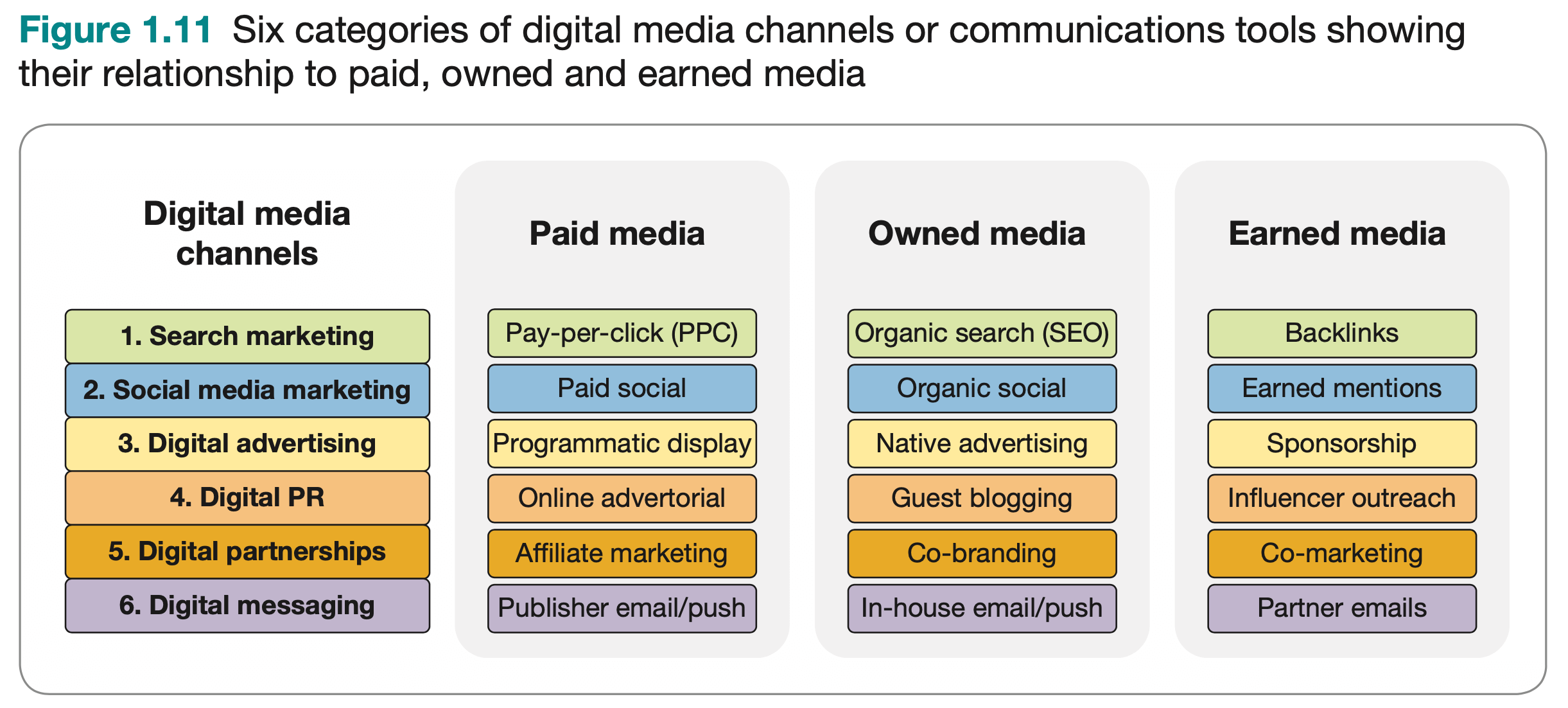
The best strategy is to use a mix of paid, owned, and earned media to reach your audience in different places. (Check out this awesome chart that Smart Insights created to show the different applications of paid, owned, and earned media for different marketing channels!)
As you publish your content in various ways and promote it on various channels, make sure you draw people back to the place where all your content lives. For most businesses, this is your website with a blog. For others, it could be a YouTube channel if most of your content is in video. Wherever it is, you want to lead people to your gold mine and have them fall down the rabbit hole.
Some KPIs you can monitor in this stage include the number of unique visitors to your website, the number of followers on a particular channel, and impressions of a paid ad.
Stage 2: Act
The next step down the funnel is for encouraging customers to take the next step. This is their decisionmaking stage, and you should aim to narrow down their choices and show how your business is the best option. Your content should be relevant to their pain points, inspire them to use your business’ solution, and enable them to make their decision. Ideally, this stage is creating solid leads for your business.
Some KPIs for this stage include the number of leads, your lead conversion rate (if they skip straight to purchase), the amount of time spent on your website, and social media engagement via shares, comments, and likes.
Stage 3: Convert
We’ve reached the most-analyzed part of the funnel: the purchase point. Buyers have made their decision and are moving forward with your products or services. One key aspect of the RACE framework is that even though it’s built for digital marketing, it still tracks offline sales as well as online activity.
A tip for converting your audience to paying customers is to leverage marketing automation tools. You can deploy sophisticated email sequences, retargeting campaigns, abandoned cart messaging, and more. The power of your database can be used to ensure the right audience is converting, leading to satisfied customers.
KPIs for this stage are pretty obvious: sales (both online and offline) and revenue. You can also calculate the average order value to see if your audience is converting on higher-value options.
Stage 4: Engage
This final step of the funnel is my favorite, favorite part! Engaging customers long-term and building loyalty is one of my points of pride in my business. I firmly believe that if I treat my customers like the golden people they are, they will not only return to me and request my services again but also advocate for me in the form of referrals.
Customer advocacy doesn’t just mean referrals, though. Any time one of my happy customers comments on a social media post or gives me a testimonial, they are bolstering my social proof. As we know, social proof pretty much drives all business these days. People trust other people, even if they don’t know them—which is why online reviews can make or break a company’s reputation.
At this stage, KPIs you can use include the number of repeat purchases, the lifetime value of each customer, and customer satisfaction or NPS.
I’ve Got Work to Do…
Writing out this post made me realize that I haven’t applied the RACE framework to my own digital marketing strategy in a while. I have not been as consistent about posting as I should be, and it’s hurting my reach. However, I am killing it at the customer engagement stage, if I may say so!
What do you think? Do you like the RACE framework? What areas can you improve your digital marketing strategy? I’d love to hear from you!